A Republic, If You Can Build It
April 21, 2026Alex Karp is a dipshit.

Karp named his company after a cursed seeing-stone, an object that offered the user total vision and corrupted everyone who looked into it. In the book the palantíri are broken, hidden, or held by the very few who know better than to trust them; the characters who survive are the ones who put the stone down. Last week his company's official account posted a 22-point summary of The Technological Republic, the book he co-authored last year. The thread reads like a man speaking from inside the stone.
Palantir's official bio reads "Software that dominates." The manifesto that follows is an elaborate justification for a single proposition, that the highest purpose of the most powerful technologies of our era is to dominate other human beings, and that anyone who thinks otherwise is decadent.
The hypocrisies are dense.
- Karp calls for universal national service (#6), but the call comes from a billionaire who will not serve, addressed to a generation that will.
- He demands "grace" for those in public life (#9, #18) while running a company whose core product is the surveillance of public and private life alike.
- He decries "the tyranny of the apps" (#2) while operating one of the most powerful pieces of consumer-pattern software ever built, just one whose users happen to be governments rather than teenagers.
- He laments the "intolerance of religious belief" (#20) from inside one of the most elite, secular, credentialed strata in human history.
- He wants the postwar pacifism of Germany and Japan undone (#15), a sentence so historically reckless I had to read it three times to confirm it said what I thought it said.
The myopia is worse than the hypocrisy. Read the 22 points and try to find a single concrete thing software should do for an ordinary person. There isn't one. There's no school in this republic, no hospital, no bus, no water main, no nurse, no teacher, no child. The only verbs are defend, dominate, deter, build weapons, rebuild militaries, address crime via surveillance. The things that actually kill Americans, overdose and car crashes and suicide and preventable disease and heat and loneliness, don't appear, because they can't be addressed by the kind of software the author sells. So they have been quietly read out of the definition of what matters.

Alex Karp
the stone's vocabulary
This is what the stone shows him. It was built to see enemies, to locate and range and strike them, to concentrate sight into the service of war. A man holding one sees a certain kind of world, in a certain kind of light, and if he looks into it long enough he comes to believe that is the only world there is. The stone doesn't lie, exactly; it just can't display the part of human life that doesn't fit through its optic. So the school and the hospital and the sidewalk and the child walking home disappear from the definition of what matters, because the stone has never had anything to say about them.
The gardener's box
In the same book that gave Karp his company's name, the sign of a restored kingdom is not a stone but a tree. In the courtyard of the healed city stands a sapling, found by the rightful king on a mountain and replanted in the open, where everyone can watch it grow. And the quieter civic miracle of that book is the one almost no one quotes. An ordinary gardener, given a small box of earth and a single seed by someone wise enough not to keep them for herself, walks home after the war and plants the seed across a countryside that an industrial tyrant has wrecked. The next year is the best in living memory.
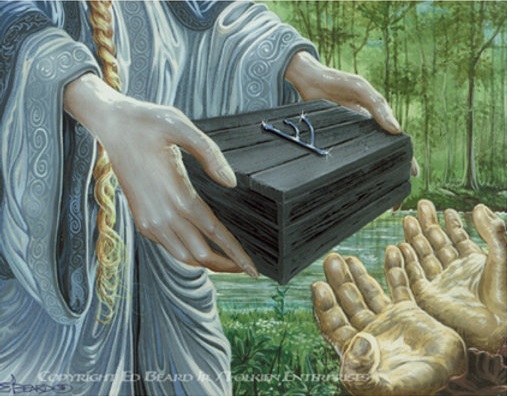
These are Tolkien's oldest argument: the work of civilization is planting.
Serious people don't have to accept Karp's trade. The most ambitious version of what advanced software, robotics, and AI could do over the next fifty years has almost nothing to do with deterrence and almost everything to do with repair. The next great American company in this space will look more like a public works department with a research lab attached.
So here, in the same form and the same cadence Karp used, is the version I would have written.
The planted republic.
1. Silicon Valley owes a moral debt to the world that made its rise possible. The engineering elite of Silicon Valley has an affirmative obligation to participate in the repair of the country and the planet, its sidewalks, its water, its grid, its schools, its rivers, its air. The debt is paid in public goods, not in munitions.
2. We must rebel against the tyranny of attention. The smartphone was a beginning, not an end. The next era of computing should disappear into the world, into instruments, streets, soil, looms, kilns, lab benches, robots that sweep the curb at dawn, extending human capacity rather than capturing the human gaze. The screen is a tool, not a destination.
3. Free email is the floor, not the ceiling. A civilization is judged not by its GDP but by what it makes possible for its weakest members. Real prosperity is measured in reduced suffering, expanded leisure, longer lifespans, cleaner watersheds, shorter commutes, and the ordinary grace of a child being able to walk safely to school.
4. The limits of hard power, of force alone, have been exposed. The deepest victories of the last century were won by ideas, art, immigration, openness, scientific generosity, and example. Software's highest calling is to extend that work, to spread literacy, translation, medicine, music, and access, power as attraction rather than coercion.
5. The question is not whether powerful technology will be built; it is for what. Adversaries are not an excuse for the surrender of judgment. We have, before, agreed not to build certain things, bioweapons, chemical weapons, blinding lasers, human clones, and our civilization survived the restraint. It will survive this one too. The interesting frontier is not autonomous killing but autonomous healing, building, teaching, growing.
6. National service should be a universal invitation. Service to the polity wears many faces: teaching, planting, building, caring, repairing, recording. A healthy republic finds dignified, well-compensated work for every citizen who wishes to give it, and never forces a young person to kill in order to belong.
7. If a nurse asks for a better tool, we should build it. The same craftsmanship and capital we lavish on rifles and missile guidance should be lavished on the instruments of care: better wheelchairs, better hearing aids, better classroom software, better trucks for the people who plow our streets at four in the morning. The dignity of a tool reflects the dignity we assign to its user.
8. Public servants are the walls that hold the republic up; remove them and it collapses. Pay them generously, train them deeply, equip them well, protect them from cruelty, and trust them with real authority, and the work itself will draw the best people in the country.
9. We should show far more grace toward everyone, not only the powerful. A culture capable of metabolizing mistakes, by ordinary people, by leaders, by itself, is more resilient than one that demands perfection. Forgiveness is a public good, and like most public goods it has been chronically underfunded.
10. Politics is downstream of how we treat each other. The political arena will not nourish a soul that has been starved at the dinner table, the workplace, the group chat. Tend to the small scale, the neighborhood, the classroom, the shop floor, and the large scale tends to follow.
11. There are no enemies, only neighbors we have not yet understood. The end of a conflict is an occasion for repair, not for victory laps. A society that learns to grieve even the deaths of its opponents is a society that has matured past the adolescent phase of its own power.
12. The age of deterrence is ending. The era that follows should be one of mutually assured prosperity: shared infrastructure, shared science, shared atmosphere, shared orbit, shared seabed, shared genome. The same minds that designed weapons capable of ending the world can design systems capable of sustaining it.
13. No country has a monopoly on progress. Every nation has a story of advance and a story of harm, and the most useful posture toward any of them is humility, to learn from any people, anywhere, who have figured out how to govern, build, heal, or live well. The United States is, among other things, a country that has done this borrowing better than most. It should keep doing it.
14. The long peace was made by many hands. Diplomats, dissidents, treaty negotiators, citizen exchanges, sister cities, foreign students, doctors without borders, and ordinary people who chose, again and again, not to fight, these built the long peace as much as any aircraft carrier did. The peace will be extended by the same broad effort, not by hegemony alone.
15. The postwar restraint of Germany and Japan is a moral achievement. Two of the most violent nations of the twentieth century became two of the most peaceful, and the world is measurably better for it. Far from undoing this, we should be asking what other nations, including our own, could learn from the discipline of voluntary restraint.
16. We should applaud builders, especially the ones working without grand narrative. The small contractor, the open-source maintainer, the city engineer, the inventor in a garage, the nurse who designed a better intake form, the teenager who fixed her school's website, heroism is widely distributed and rarely televised. A healthy culture notices the quiet builders before it canonizes the loud ones.
17. Technology's contribution to public safety should be to address causes, not to surveil symptoms. Violence has roots in housing, mental health, addiction, isolation, and economic precarity. Safety is made by neighbors. The technologies worth building are the ones that make a neighborhood more legible to itself: better lighting, better transit, better third places, better tools for mutual aid.
18. Public service should be a place where talented people are proud to spend a decade. The way to attract excellence to government is not to insulate officials from criticism but to give them real problems, real authority, real budgets, real teams, and real respect. Bureaucracy reform is the most underrated frontier in American politics.
19. Plain speech, including the admission of uncertainty, is more valuable than performative certainty. We should encourage our leaders, our scientists, and our institutions to think out loud, to say "I don't know," to revise their views in public, and to disagree without contempt. The republic is strong enough to hear honest reasoning.
20. The contemplative traditions, religious and secular, hold wisdom modernity has underdrawn from. Buddhism, Christianity, Judaism, Islam, Hinduism, Stoicism, indigenous practice, and a hundred other lineages have spent millennia investigating attention, suffering, ethics, death, and meaning. Generosity toward these traditions, and toward the people who practice them, is a sign of intellectual maturity, not weakness.
21. Every culture has produced wonders and produced harms. The work of a free society is not to rank cultures but to draw freely from any tradition, any cuisine, any architecture, any music, any moral practice, any agricultural method that helps human beings live well together on a finite planet.
22. A real pluralism is not vacant; it is the active, generous practice of including more people in the project of building a good world. Inclusion into what? Into the work of repair. Into the work of feeding, housing, educating, healing, transporting, and delighting each other. Into the endless, unfinished, magnificent human project of making this place, this street, this city, this country, this planet, a little more habitable than we found it.

the gardener's vocabulary
What this means, if you build things.
I write this, for what it's worth, as someone adjacent to the same trade. My company builds autonomous robots for cities: sidewalk cleaning, snow removal, the unglamorous physical labor that keeps a place habitable. The same NVIDIA silicon. The same deep learning stacks. The same young engineers who could be hired by Palantir could be hired by me. We are, in a small way, competing for the same talent and the same vision of what advanced engineering is for.
There are two visions, and you are quietly being asked to pick one.
The first is Karp's. In it, the smartest people of your generation work on systems that watch other people, predict other people, target other people, deter other people, and, when the time comes, kill other people. The customer is the state. The product is dominance. The metric is hegemony.
The second is older, less famous, and more boring. In it, the smartest people of your generation work on systems that move water, grow food, teach children, heal bodies, sweep streets, restore rivers, plant trees, and quietly raise the floor of what an ordinary human life feels like. The customer is the city. The product is repair. The metric is whether your grandchildren want to live here. In the book, the palantíri were broken or buried, and the tree was replanted.
Both futures will use the same chips. Both will use the same algorithms. Both will hire from the same five universities. The technologies don't care which republic they're built for.

You do.